Board games for two are a special category of games, specializing in providing the best experience of board-gaming when the player count is just that. Many games designed for a higher player count provide a similar good experience for 2-player games, others incorporate a special 2-player variant to make their game equally interesting for two players and others just not particularly bother but everyone agrees that designing a game for just 2 players presents a difficult challenge. Tokaido is designed by Antoine Bauza and has been in the board game market quite a few years, from 2012. It revolves around travelling along the famous “East Sea Road”, one of the most magnificent roads of Japan. Tokaido Duo is a game by the same designer, inspired from the original game but featuring different mechanics.
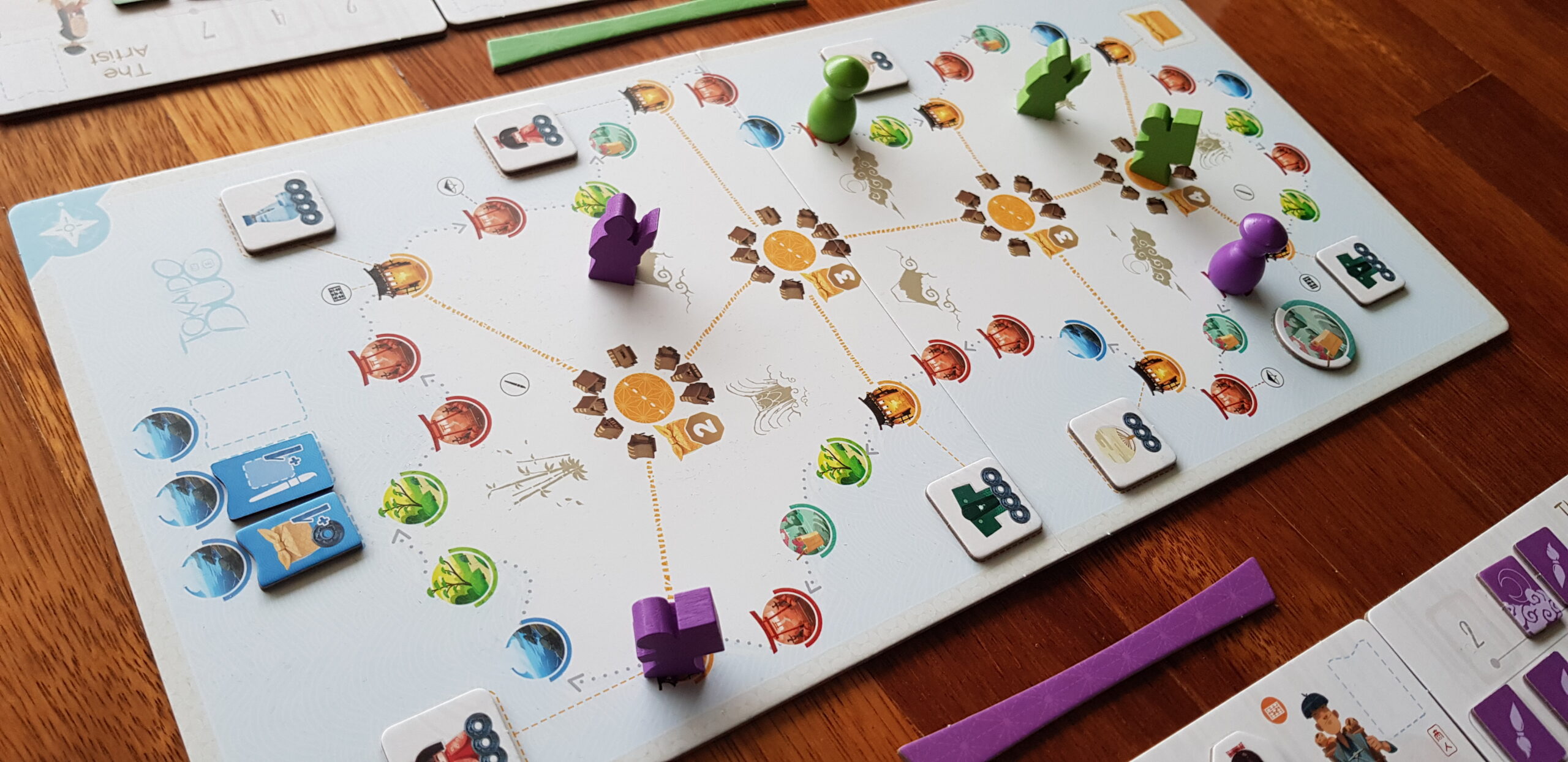
Gameboard
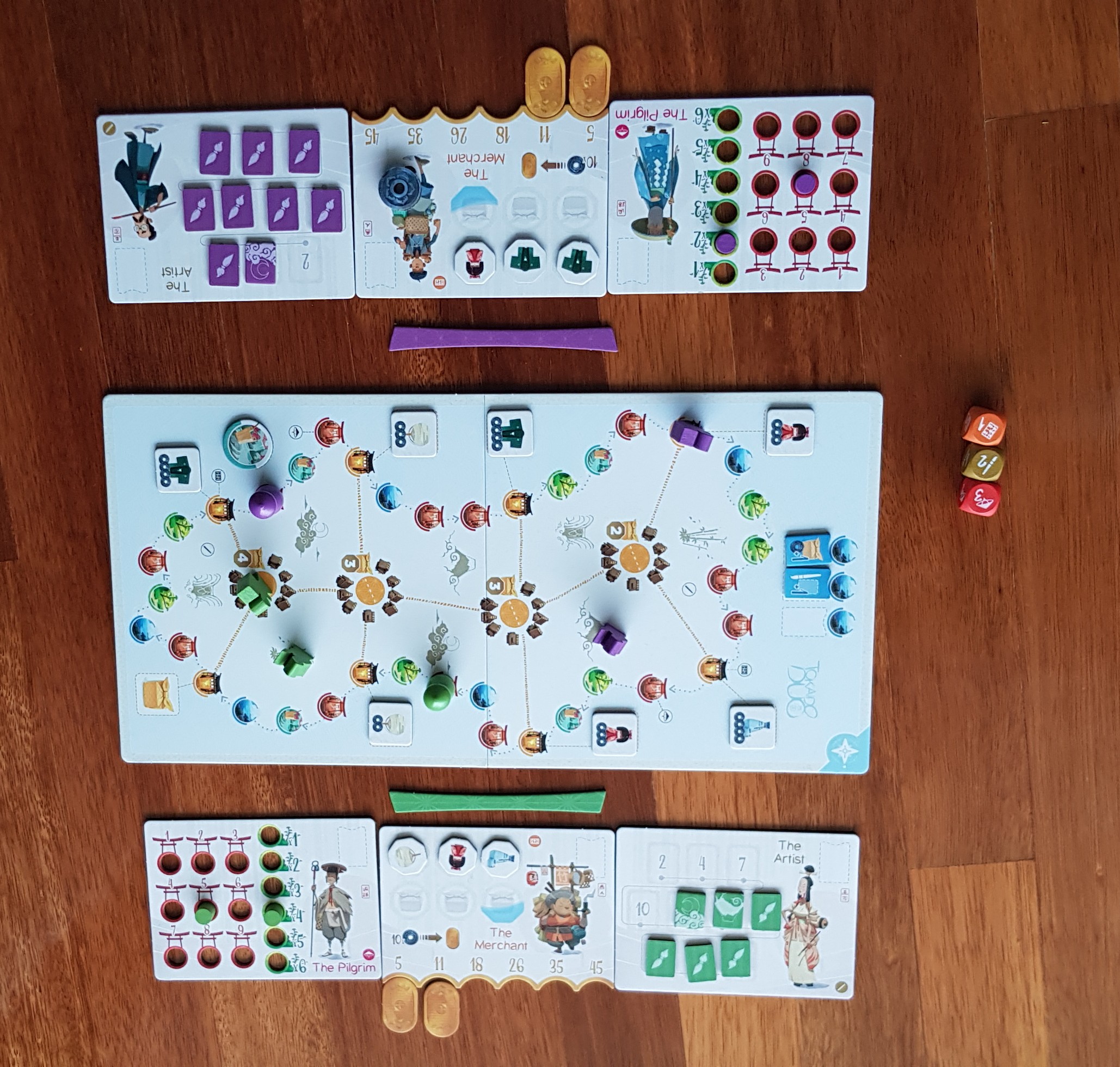
In Tokaido Duo, you will control three different characters, a pilgrim, an artist and a merchant, travelling through Shikoku, the smallest of the four main islands of Japan. Shikoku features a spectacular 88-temple pilgrimage. In reality the pilgrimage course is about 1200 km long and is traditionally covered by foot. In the game you use 3 different dice, one for each kind of traveler, to control your characters and help them achieve their goals. Pilgrims want to visit the most temples and gardens, artists want to paint beautiful landscapes and gift their paintings to passers-by and merchants want to buy and sell interesting souvenirs.
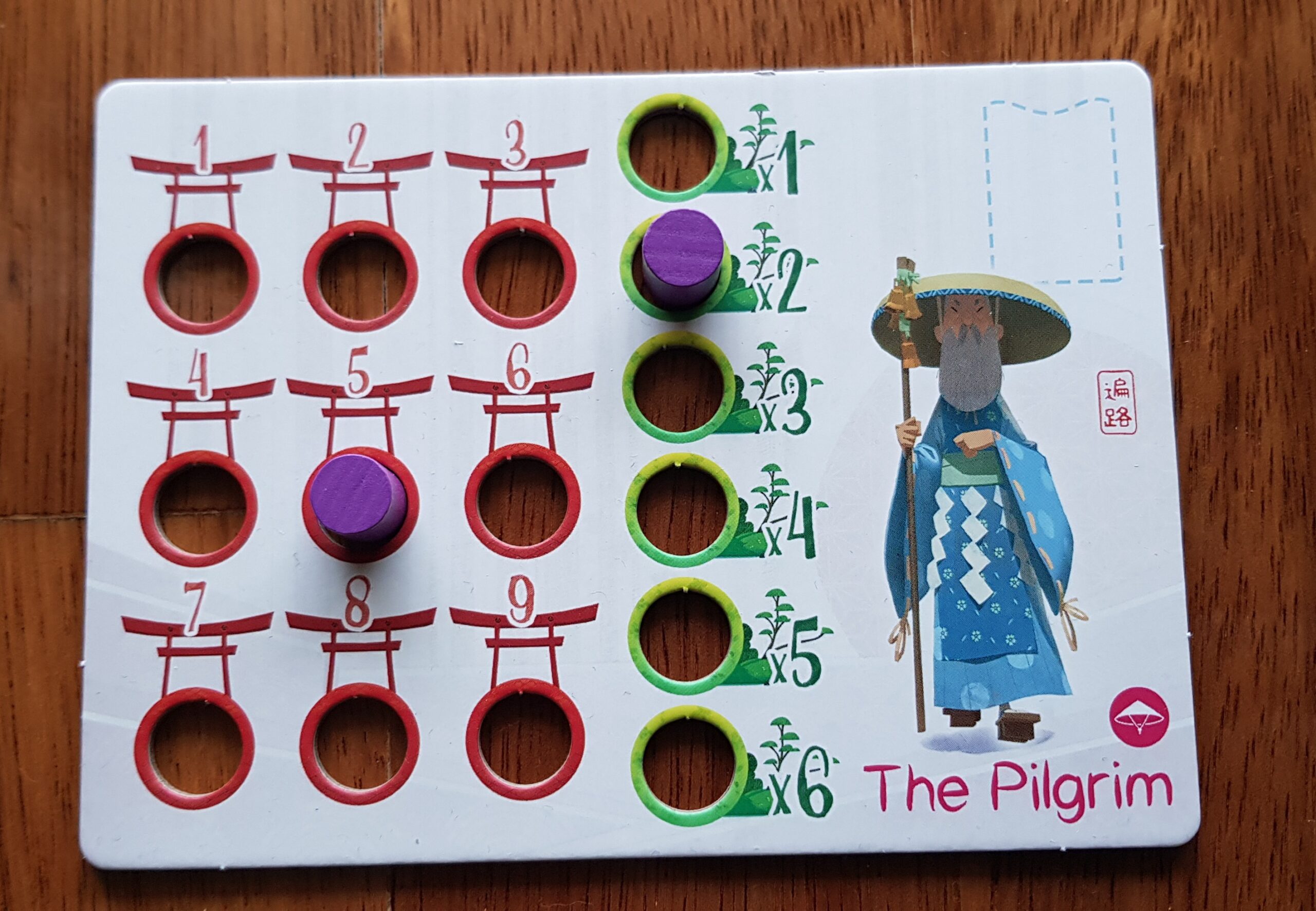
Pilgrim character board
In the game there are three dice, each one corresponding to a different character. At the start of the first turn, player A throws the dice. They then choose one of the dice to use and move the corresponding character. Then player B chooses another dice, uses it and finally player A chooses the third dice and uses it. At this point, another turn begins with player B becoming the starting player and the game goes on the same way.
Each character moves in a different way and has his own goals in the game. The pilgrim moves along the perimeter road where he can visit temples, gardens, coastal towns and hot springs trying to visit as many temples and gardens as he can. His final score will be the number of temples multiplied by the number of gardens he visited. The artist moves in areas between roads in order to paint beautiful landscapes. The number of paintings he paints is related to the people around him. His ultimate goal is to gift his paintings to passers-by and he does that if the first painting on his board has the same symbol as the symbol on the area he visits. The more paintings he sells, the more points you will get at the end of the game. The merchant moves along the roads of Shikoku, visiting either mountain cities to buy artifacts or coastal cities to sell them. His ultimate goal is to gather the most wealth by the end of the game.
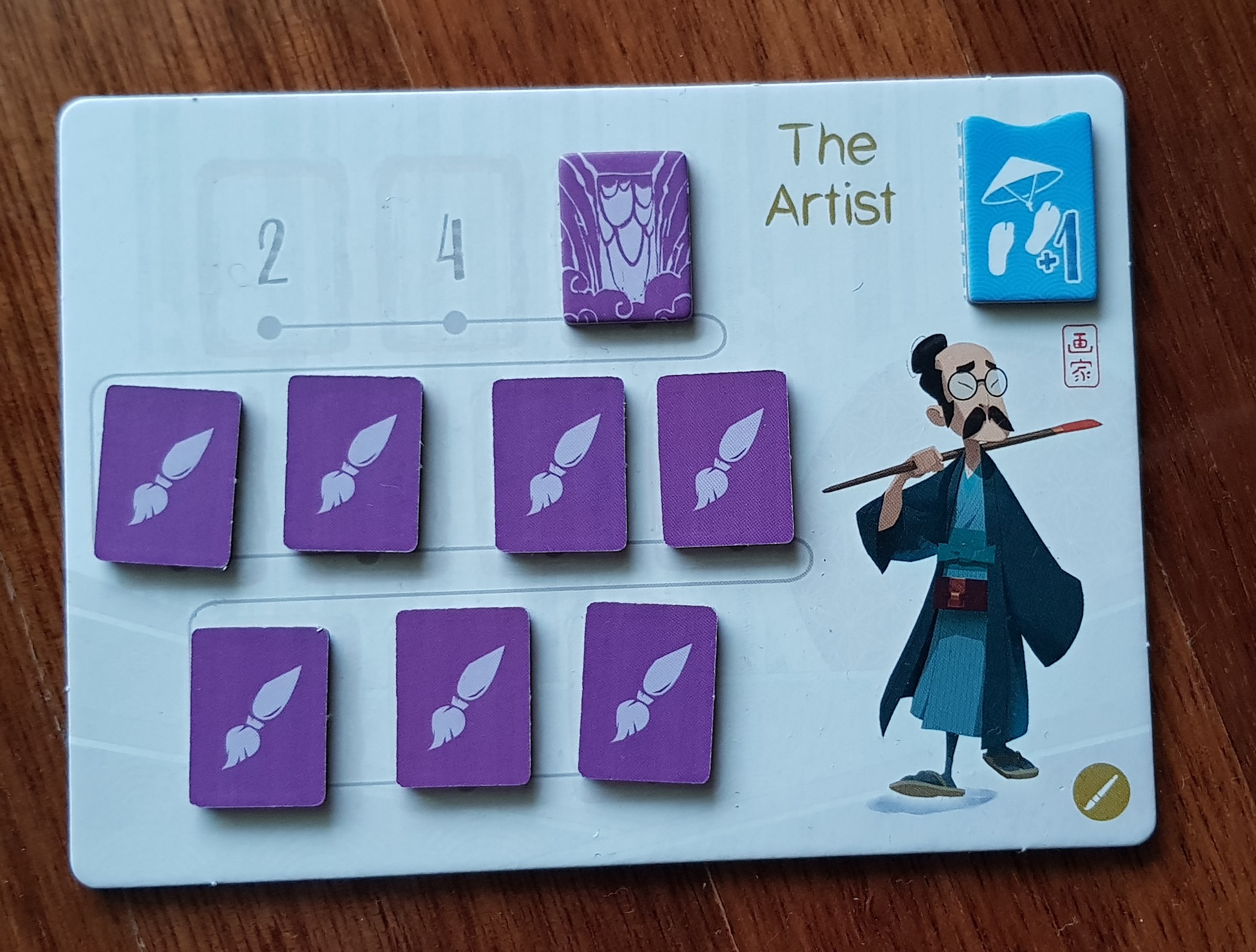
Artist character board
Now let’s go and see how the game scores in our scoring categories:
Components
Stonemaier games never lets us down regarding the quality of its game components and this is no exception. The gameboard is made of hard cardboard and is beautifully illustrated. All tokens and character boards are also made of hard, thick cardboard. Meeples and pegs are made of wood. The different character meeples are distinguishable by their unique shape. It’s nice that separate sets of character rules have been made for each player to have one handy nearby. The cloth bag for the ware tokens is rather simple. Maybe a more fancy one, in japanese style, would be better if that wouldn’t have a high toll on the game’s price. All in all components quality is superb. 9/10
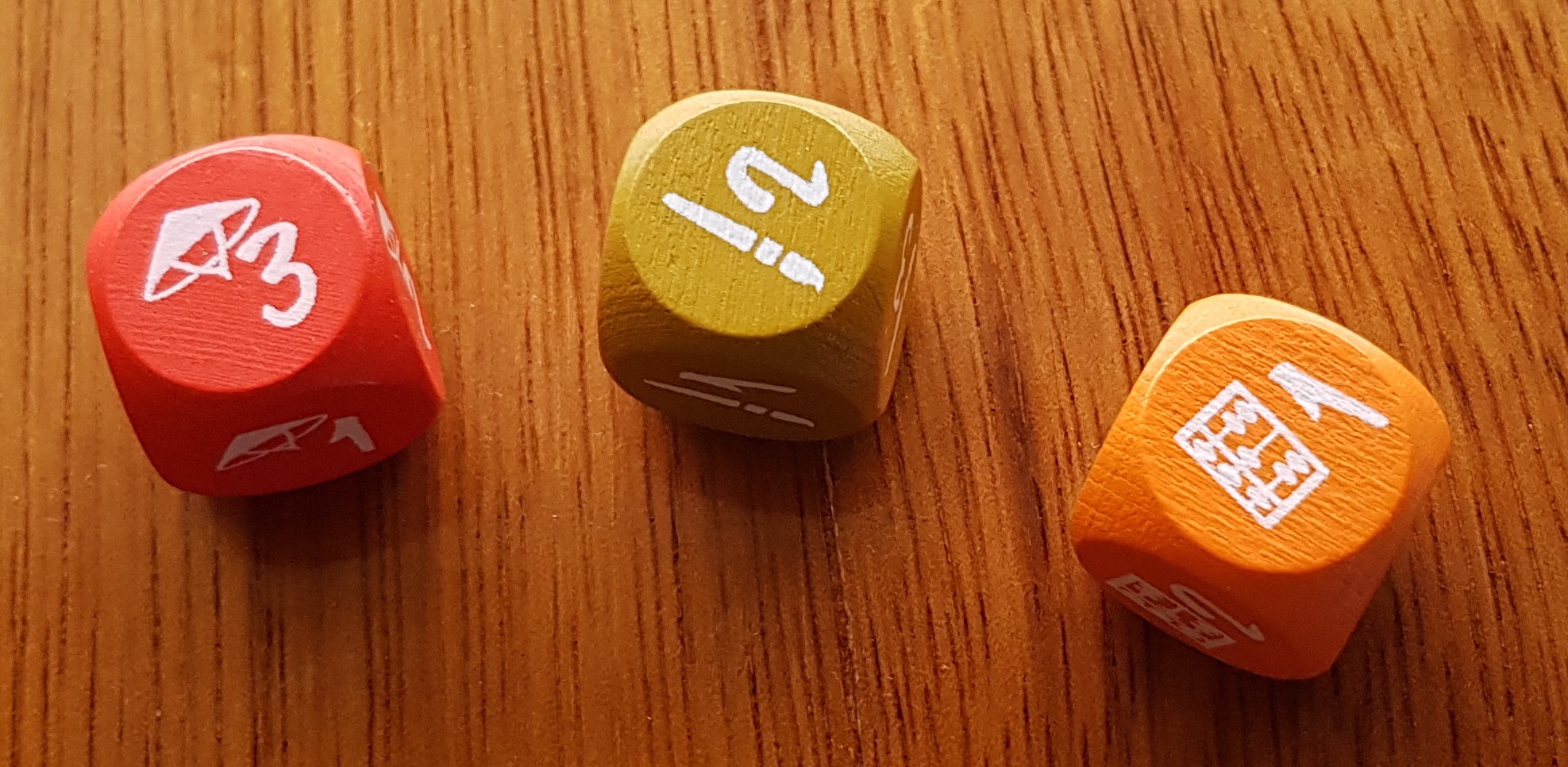
Dice of the game
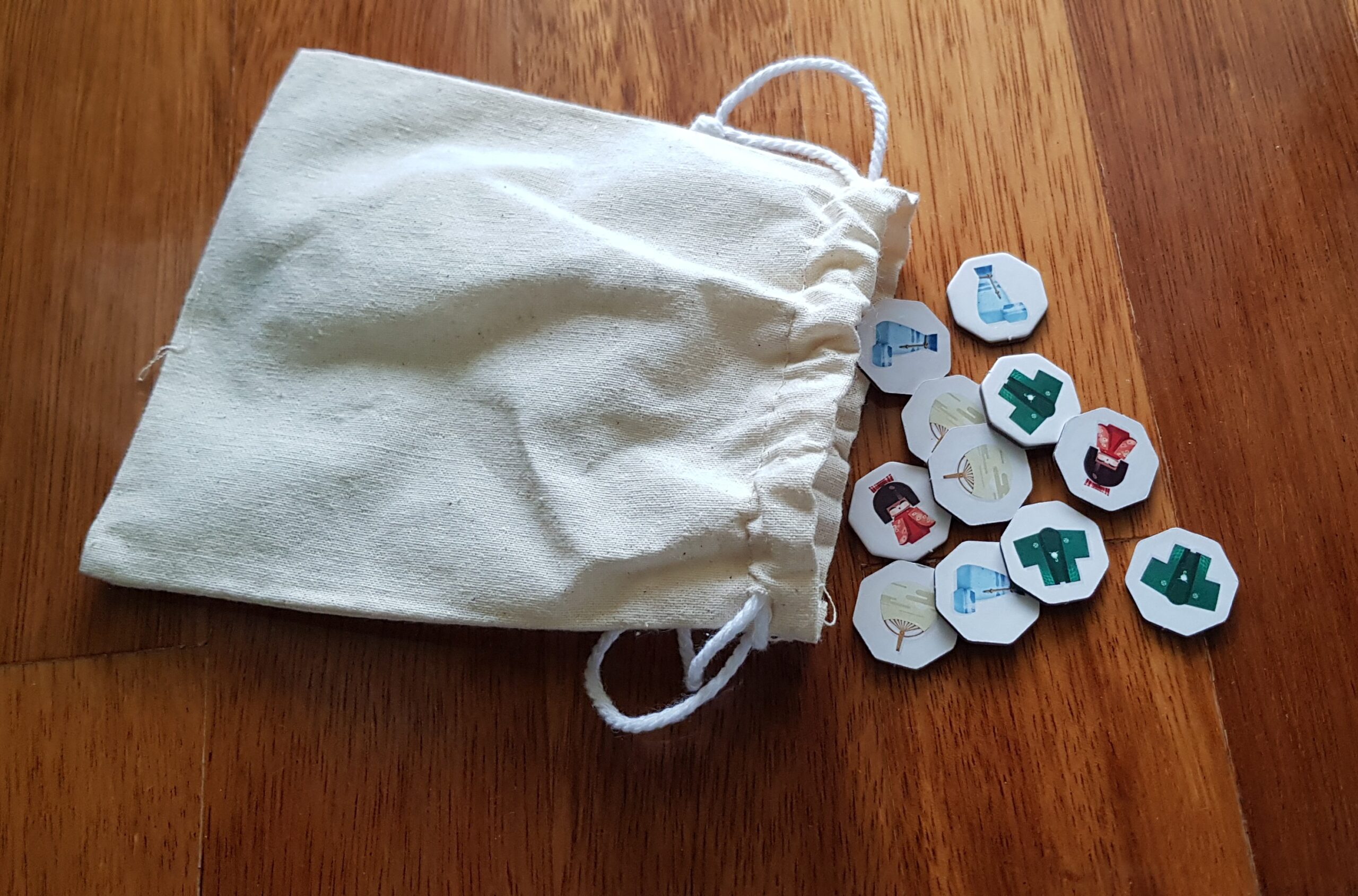
Bag and ware tokens
Gameplay
For starters, the game setup takes some time. Each time you will want to play, except if you played this game many times recently, you must carefully read the setup steps so that nothing is forgotten. However gameflow itself is rather straight forward. One of the two players throws the dice. Then he/she chooses one of them and moves the corresponding character. Then the other player chooses a dice and moves the corresponding character. Finally the first player chooses the last dice and moves their character. This a typical round of the game and it goes on until one or more characters reach their goal: either the painter gifts all of his paintings or the merchant grabs his 6th gold slab or the pilgrim gets to visit all temples or gardens. That said, gameplay repeats itself without much variation throughout the game.
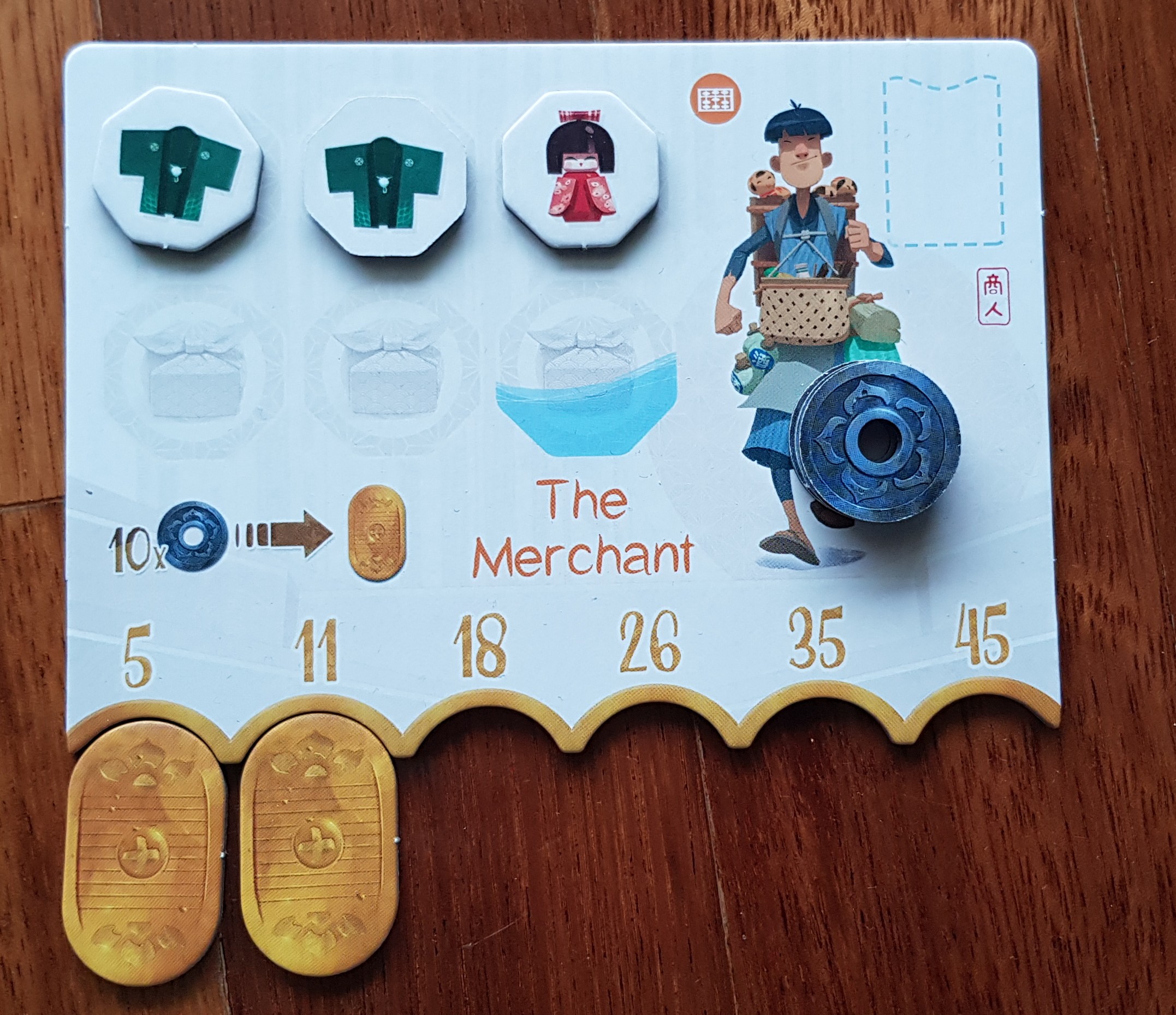
Merchant Character board
The most important decision you will have to make is which character to choose. That doesn’t sound like a lot and it really isn’t. Some variation to the game comes from collecting the “hot springs” token which allows you to reuse the dice you just chose one more time, which is mostly fun and allows you to obtain a small advantage. Wave tiles on the other hand seem rather important because they give your characters an “eternal” boost for the whole game so you should grab them as soon as you can. That gives a small strategic boost to the game, as it gives you something more to think about during the game.
Variation in gameplay in Tokaido definitely comes from the different way each character is played. Each character has each own rules of moving and interacting with the environment with the pilgrim maybe being the most weak and straightforward character as he just moves along the road. However he is the one collecting the hot spings and the wave tiles and that gives him a boost. The merchant’s gameplay includes the element of luck, because you don’t know what you will pull from the little bag with goods. As only one merchant must occupy a town he requires attention in doing the right moves the right moment. The painter also requires some thinking especially during the draw phase as he must be around a lot of people to paint as many paintings as he can.
All in all I found gameplay a bit dull in relation to other 2-player games, and that may have to do with the lack of player interaction which I think is crucial especially for a 2-player game. 6/10
Theme
The theme of the game is original and very interesting. The gameboard successes in capturing the feeling of the island and gets you to feel you are traversing the beautiful gardens, temples and cities spread in Tokaido. The characters’ movement is directly related to their purpose. The pilgrim does indeed move from one temple to the other and in a specific direction (clockwise). It would be really weird if he went back and forth along the way. However it remains a mystery why he should get money from the coastal towns he visits. It would be more natural to spend money there for provisions for his journey. The merchant’s movement is all the way logical: he visits mountain towns to get supplies and coastal towns to sell them. The artist very naturally moves in the heart of the island in order to paint but everything else about him is really strange. Why should he paint that many paintings as the number of characters around him? Moreover why should he gift a painting when there is a corresponding symbol in the area he visits? I understand that it’s not easy to match a character’s real intent with gameplay mechanics in a game but when we are talking about theme I must mention facts like these. All in all the game remains quite thematic indeed despite the mishaps mentioned. 7/10
Player Interaction
You know this is my favourite section each and every time and God knows how this game disappoints me here. The only way that player interact in Tokaido and that is only indirectly, is when one of the two players places a merchant in a town thus blocking the other merchant from visting the town, which really isn’t much of a fuss. A two-player game where each player plays by himself just doesn’t seem much fun but some may argue that it is just fine. And sometimes it really is, if there is a more solid gameplay that could absorb you and make you not care about anything but yourself. On the other hand it also depends on the theme of the game. We are talking about peaceful people that move through this island and probably don’t have the slightest intent of sabotaging their fellow pilgrims, merchants or painters. That said maybe I should be more lenient with the “aggression” element of the game, but I really can’t help it. 4/10
Learning Curve
Tokaido Duo rules are very simple. As soon as you understand how each character moves and plays, you’ve learned it all. All there is to do in the game, is choose a dice and move a character. A special rulebook for each player is available to use during play, in case you forget a detail, which is super helpful. This is a family game, suitable for children and adults alike. 9/10
Replayability
After finishing my first game, I immediately felt ready to play another game which I did. After a couple of games, however, excitement began to fade away and I felt like gameplay was kind of repeating itself with every game. All there is to think about, is choosing the right meeple to move every time but the meeples’ moves are always the same and there are no expectations or surprises waiting for you with each and every game. This is a game I wouldn’t mind to play if someone else suggests it but it wouldn’t be one of my first choices if I was to propose a game. With so many other choices of two-player games out there, Tokaido Duo merely makes the cut for good 2-player games. 6/10
Final Thoughts
Tokaido Duo is a board game for two, with an original theme and great components. Gameplay is rather straight-forward and can be really enjoying if you are looking for a light family game. However, after some games, gameplay can seem rather repetitive given the fact that there is also very little player interaction. You should definitely check this out if you are into Japan-themed games.